
Showing posts with label Krebs Cycle. Show all posts
Showing posts with label Krebs Cycle. Show all posts
Video about the Krebs cycle (3)
This video is different... it is a Legos's version of the Krebs cycle! :)
Krebs cycle (reactions) - part 2

Reaction 5: conversion of succinyl-CoA to succinate This reaction requires Mg2+. The enzyme that catalyzes this reaction, succinyl-CoA synthetase, breaks the thioester bond (S-CoA), releasing a large amount of energy that is used to phosphorylate GDP to GTP. It is another example of an energy coupling.

Reaction 6: oxidation of succinate to fumarate
Succinate is oxidized to fumarate, leading to the production of FADH2 from FAD. The reaction is catalyzed by succinate dehydrogenase, which is the only Krebs cycle enzyme that is not present in the matrix, but instead is strongly associated with the inner membrane of mitochondria.

This enzyme is highly stereo-specific, producing only the stereoisomer L-malate. The reaction is reversible in cellular conditions.

This reaction produces a molecule of NADH from NAD+. At the intracellular conditions, the reaction is mainly driven in the opposite direction, but as the oxaloacetate is continuously removed (by the reaction of synthesis of citrate, by gluconeogenesis or by transamination to originate aspartate), the equilibrium is shifted in the forward direction. The oxaloacetate used in the first reaction of the Krebs cycle is then regenerated, so, theoretically, one molecule of oxaloacetate may be involved in the oxidation of an infinite number of molecules of acetyl-CoA (playing a kind of "catalytic" role) and, therefore, the oxaloacetate is present in cells at very low concentrations.
Main bibliographic sources:
- Quintas A, Freire AP, Halpern MJ, Bioquímica - Organização Molecular da Vida, Lidel
- Nelson DL, Cox MM, Lehninger - Principles of Biochemistry, WH Freeman Publishers
Video about the Krebs cycle (2)
Here it goes one more video about the Krebs cycle, this time in a karaoke version. :)
Krebs cycle (reactions) - part 1

Reaction 1: formation of citrate
This irreversible reaction is the 1st regulatory point of the Krebs cycle. It is a reaction in which an oxaloacetate molecule reacts with acetyl-CoA. In this process it is formed a very energetic intermediate (citroil-CoA) that rapidly converts into citrate. The molecule of CoA-SH liberated is recycled to participate in a new oxidative decarboxylation of pyruvate (catalyzed by pyruvate dehydrogenase complex).
This irreversible reaction is the 1st regulatory point of the Krebs cycle. It is a reaction in which an oxaloacetate molecule reacts with acetyl-CoA. In this process it is formed a very energetic intermediate (citroil-CoA) that rapidly converts into citrate. The molecule of CoA-SH liberated is recycled to participate in a new oxidative decarboxylation of pyruvate (catalyzed by pyruvate dehydrogenase complex).

Reaction 2: formation of isocitrate via cis-aconitate
This reaction occurs through the formation of an intermediate, cis-aconitate, obtained by dehydration of citrate. Thereafter, the cis-aconitate is hydrated, forming isocitrate. Thus, citrate and isocitrate are isomers. Despite that in cellular conditions the reaction produces only about 10% of isocitrate, the rapid consumption of this product in the following reaction shifts the equilibrium in the forward direction. The fluoroacetate is a toxic molecule because in physiological conditions it is transformed into fluoroacetil-CoA, which condenses with oxaloacetate to form fluorocitrate, that inhibits aconitase, causing accumulation of citrate.

Reaction 3: oxidation of isocitrate to α-ketoglutarate and CO2This reaction is an example of an irreversible oxidative decarboxylation, and it is the 2nd regulatory point in the Krebs cycle. In fact, this reaction is a set of three different reactions:
1. Dehydrogenation of isocitrate, creating oxalosuccinate and producing NADH.
2. Binding of Mn2+ to the carbonyl group of oxalosuccinate, stabilizing the enol and promoting the release of CO2.
3. Hydrogenation, with the arrangement of the resonance hybrid.
1. Dehydrogenation of isocitrate, creating oxalosuccinate and producing NADH.
2. Binding of Mn2+ to the carbonyl group of oxalosuccinate, stabilizing the enol and promoting the release of CO2.
3. Hydrogenation, with the arrangement of the resonance hybrid.

Reaction 4: Oxidation of α-ketoglutarate to succinyl-CoA and CO2This reaction, like the previous one, is another example of an irreversible oxidative decarboxylation. It is the 3rd (and the last one!) regulatory point of the Krebs cycle. This reaction is virtually identical to the oxidative decarboxylation of pyruvate, also leading to the formation of NADH. It is a very exergonic reaction due to the energy stored in the bond S-CoA.
Main bibliographic sources:
- Quintas A, Freire AP, Halpern MJ, Bioquímica - Organização Molecular da Vida, Lidel
- Nelson DL, Cox MM, Lehninger - Principles of Biochemistry, WH Freeman Publishers
Krebs cycle (general ideas) - part 2

For each round of the Krebs cycle, three molecules of NADH, 1 FADH2, 1 ATP (GTP) are produced.
The passage of electrons from a molecule of NADH to O2 on oxidative phosphorylation leads to the formation of 2.5 molecules of ATP. If the donor electron is the FADH2 only 1.5 molecules of ATP are formed. Therefore, one molecule of glucose that is completely oxidized to CO2 via glycolysis, pyruvate dehydrogenase, Krebs cycle and oxidative phosphorylation, produces 32 ATP molecules.
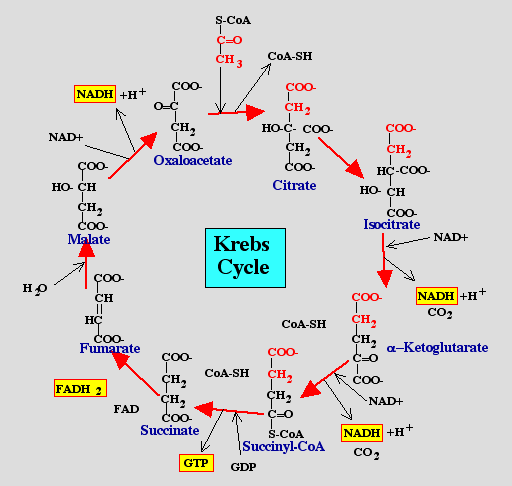

The Krebs cycle plays a central role in cellular metabolism, because all the nutrients that may play a role "energy" generated in its catabolism acetyl-CoA.In addition to oxidize acetyl-CoA to CO2 and to produce ATP, NADH and FADH2, also receives several intermediaries arising from several catabolic pathways. Oxaloacetate and α-ketoglutarate, for example, are the products of decomposition of aspartate and glutamate. In addition to receiving several intermediates from catabolic processes, it also provides various intermediates for anabolic pathways. Because of this feature (involvement on both anabolic and catabolic processes) the Krebs cycle is an amphibolic process.
Oxaloacetate and α-ketoglutarate are also precursors of amino acids and purine and pyrimidine bases. Oxaloacetate is converted to glucose in gluconeogenesis, succinyl-CoA intermediate in the synthesis of the porphyrin ring of heme groups.

When the Krebs cycle intermediates are diverted to biosynthetic processes, their stock quantity is replenished by anaplerotic reactions. The most important reaction in the liver and kidneys is the reversible carboxylation of pyruvate to oxaloacetate. The enzyme that catalyzes this reaction is pyruvate carboxylase and is stimulated by acetyl-CoA. Another important reaction is the carboxylation of phosphoenolpyruvate to oxaloacetate. The enzyme that catalyzes this reaction is phosphoenolpyruvate and is stimulated by fructose-1,6-bisphosphate. Other important anaplerotic reactions are transaminations, to obtain amino acids (the intermediate of cycle provides the carbon skeleton). The cycle also provides intermediates in the synthesis of glucose (gluconeogenesis) and fatty acids.
Main bibliographic sources:
- Quintas A, Freire AP, Halpern MJ, Bioquímica - Organização Molecular da Vida, Lidel
- Nelson DL, Cox MM, Lehninger - Principles of Biochemistry, WH Freeman Publishers
Krebs cycle (general ideas) - part 1
The Krebs cycle is also called the citric acid cycle or the tricarboxylic acids cycle. It is a catabolic process that occurs in mitochondria, specifically in the mitochondrial matrix (as I will highlight in a next post, there is just a reaction that occurs in association with the inner membrane of mitochondria). In the cycle, cells oxidize acetyl-CoA molecules to CO2, and the energy released is conserved in the form of NADH and FADH2. The Krebs cycle is exclusively aerobic, because although O2 does not participate directly in the cycle, the NAD + and FAD can only be regenerated in the mitochondria by transferring electrons to O2 (in the post on the regulation of the Krebs cycle, which will place soon, it will be possible to see that if NADH accumulates, that is what happens in the absence of O2, the Krebs cycle is inhibited ...).
We oxidize in the Krebs cycle many moles of acetyl-CoA per day. The oxidants, NAD+ and FAD, are reduced to NADH and FADH2. In the cell there are only a few micromoles of NAD + and FAD and within the mitochondria (where the cycle occurs) the regeneration of NAD+ and FAD depends on the respiratory chain, so the Krebs cycle does not occur under anaerobic conditions. The Krebs cycle is like a "mill" where the "grain" (the substrate) is the acetyl group of acetyl-CoA and the "flour" (products) are CO2 and electrons (NADH and FADH2), the "millstone" are the enzymes and intermediate compounds.
We oxidize in the Krebs cycle many moles of acetyl-CoA per day. The oxidants, NAD+ and FAD, are reduced to NADH and FADH2. In the cell there are only a few micromoles of NAD + and FAD and within the mitochondria (where the cycle occurs) the regeneration of NAD+ and FAD depends on the respiratory chain, so the Krebs cycle does not occur under anaerobic conditions. The Krebs cycle is like a "mill" where the "grain" (the substrate) is the acetyl group of acetyl-CoA and the "flour" (products) are CO2 and electrons (NADH and FADH2), the "millstone" are the enzymes and intermediate compounds.

Main bibliographic sources:
- Quintas A, Freire AP, Halpern MJ, Bioquímica - Organização Molecular da Vida, Lidel
- Nelson DL, Cox MM, Lehninger - Principles of Biochemistry, WH Freeman Publishers
Fates of pyruvate
The fate of pyruvate depends on cell type and metabolic conditions. There are three main destinations for pyruvate:

(1) aerobic organisms and tissues, under aerobic conditions - pyruvate is oxidized, with loss of the carboxylic group, resulting in the acetyl group from acetyl-CoA, which is then oxidized to CO2 in the Krebs cycle;

(2) Aerobic tissues in conditions of low oxygen (muscle hypoxia, for example), some tissues under aerobic conditions (red cells, for example, because they lack mitochondria), or some anaerobic organisms - pyruvate is reduced to lactate by lactic fermentation . In muscle under conditions of hypoxia, NADH is not reoxidized to NAD+ and NAD+ is required for glycolysis. The reduction of pyruvate to lactate allows the use of as a donor of electrons to regenerate NAD+;

While glycolysis can occur in anaerobic conditions, this fact has a price, because it reduces the amount of ATP formed per molecule of glucose (from 30 or 32 it passes for only 2 ATP!), and, therefore, it is needed more glucose oxidation under these conditions.

(3) Some tissues of plants, some invertebrates, protists and micro-organisms under anaerobic conditions or hypoxia - pyruvate is converted to ethanol + CO2 (alcoholic fermentation).
While glycolysis can occur in anaerobic conditions, this fact has a price, because it reduces the amount of ATP formed per molecule of glucose (from 30 or 32 it passes for only 2 ATP!), and, therefore, it is needed more glucose oxidation under these conditions.
What happens to pyruvate is directly related to the amount of NAD+ and FAD in the cell. As these amounts are very small, there must be mechanisms to transform the NADH + H+ and FADH2 back into NAD+ and FAD, respectively. This is done by transfer of the electrons from NADH + H+ and FADH2 to other molecules, which can occur by fermentation or respiration. The distinction between these is not (contrary to what is generally thought) that one of the processes uses directly the O2 and the other not! O2 is only required for oxidative phosphorylation, and not for the oxidation of pyruvate. Unlike aerobic metabolism that depends and are limited by the oxygen supply, the anaerobic glycolysis does not depend on the availability of oxygen and can increase speed up to 1000 times the speed at rest, ie, 2 ATP / glucose can represent many ATP/minute.
Main bibliographic sources:
- Quintas A, Freire AP, Halpern MJ, Bioquímica - Organização Molecular da Vida, Lidel
- Nelson DL, Cox MM, Lehninger - Principles of Biochemistry, WH Freeman Publishers
Video on the oxidation of pyruvate and Krebs cycle
Here is a video about what happens to pyruvate in the mitochondria, where it is used as an energy source. It is a very interesting video, with enough detail at the level of biochemical reactions.
Metabolic map about Krebs cycle
Here comes one more metabolic map, now about Krebs cycle.
![]()
http://www.biocarta.com/genes/Metabolism.asp
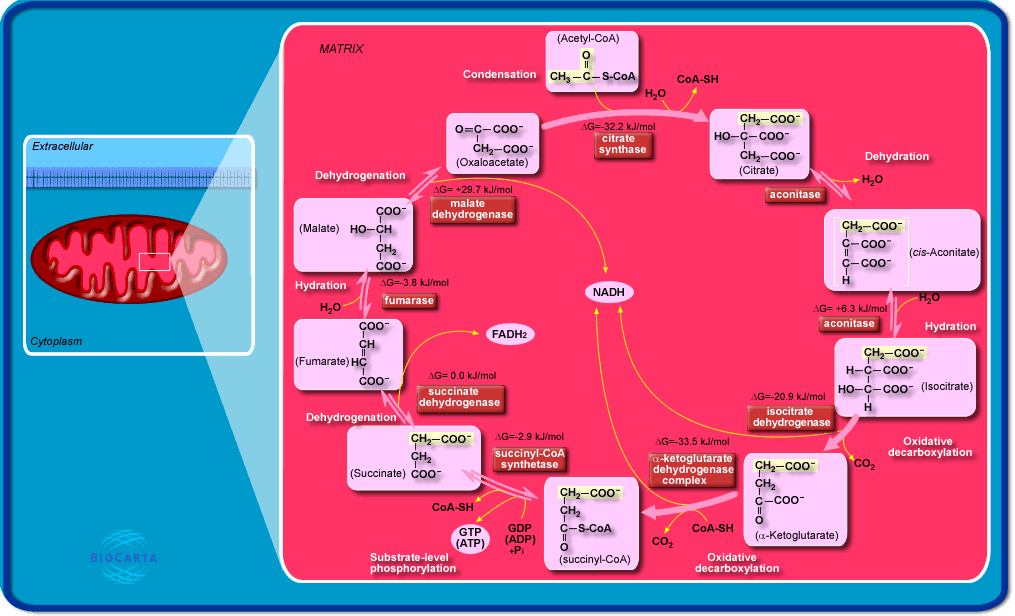
http://www.biocarta.com/genes/Metabolism.asp
Music about the Krebs cycle

Here it is one more music of Dr. Baum, this time about the Krebs cycle. This is an adaptation of the very famous Waltzing Matilda.
Krebs Cycle (main aspects)
Krebs cycle
- Type of metabolic pathway: catabolic, cyclic
- Main goal: energy production from acetyl-CoA oxidation
- Subcellular localization: mitochondrial matrix
- Conditions required to occur: aerobic
- Number of biochemical reactions: 8
- Energetic output (per acetyl-CoA molecule): +3 NADH, 1 FADH2 e +1 GTP
- Final product (per acetyl-CoA molecule): 2 CO2
Subscribe to:
Posts (Atom)


