Showing posts with label Summaries. Show all posts

Regulation of pyruvate oxidation (part 2)


The pyruvate dehydrogenase complex activity is regulated mainly by two distinct mechanisms – allosteric mechanisms and reversible covalent modification.

In fact, there are some allosteric modulators of the complex, which in this particular case belong to the class of negative modulators, ie, inhibitors of its catalytic activity:
- Acetyl-CoA – it is the product of the reaction, thus, it makes sense that the molecule of acetyl-CoA has an inhibitory effect on its own synthesis
- NADH – one of the products of the reaction is NADH, so the reasoning is equivalent to that carried over to the acetyl-CoA molecule. Furthermore, as already mentioned in other posts of this blog, NADH may be involved in ATP synthesis (in cellular respiration), so, its presence indicates a potential for a high energy state into the cell. Accordingly, and as the oxidation of pyruvate to acetyl-CoA is part of catabolism, whose main objective is to obtain energy, it makes sense that NADH inhibits catabolism and, in particular, this reaction.

Regarding the reversible covalent modification, this enzyme complex is inhibited by phosphorylation and activated by dephosphorylation. This process is mediated by two different enzymes… The one that phosphorylates is called pyruvate dehydrogenase kinase, whereas the one that dephosphorylates it is the pyruvate dehydrogenase phosphatase.
Factors that activate the kinase, leading to the phosphorylation of pyruvate dehydrogenase complex (ie, inhibitors of its catalytic activity):
- Acetyl-CoA and NADH – in addition to its direct effects on the pyruvate dehydrogenase complex, as allosteric inhibitors, these two molecules also trigger the phosphorylation of the complex, promoting its inhibition, which means that they can act, therefore, through two distinct mechanisms

Factors that inhibit the kinase, favoring the balance towards the dephosphorylated form of pyruvate dehydrogenase complex (ie, activating its catalytic activity):
- NAD+ – for this molecule it can be done the reverse rationale made for NADH. That is, the presence of NAD+ indicates an energy deficit on the cell, so it is needed to activate the catabolism to counteract this deficit.
- ADP – the reasoning is equivalent to the one mentioned above, as to say that the cell is accumulating ADP means that it is spending ATP. Thus, it will need to produce again ATP
- Pyruvate – pyruvate is the substrate of the reaction, and its presence will activate the pyruvate dehydrogenase complex by inhibiting the phosphorylation process (and thus its inhibition) of the pyruvate dehydrogenase complex
- Coenzyme A (CoA) – this cofactor plays a co-substrate role, so that its presence will affect catalytic activity of the complex in a similar manner to that described for pyruvate

Factors that activate the phosphatase, leading to dephosphorylation of pyruvate dehydrogenase complex (ie, activating its catalytic activity):
- Ca2+ - calcium ion is an important modulator of the metabolism. In this particular case, this ion acts (in the muscle) at the level of pyruvate dehydrogenase phosphatase, activating it (by promoting its dephosphorylation). Put simply, the calcium ion is an indicator of muscle contraction, so it makes perfect sense that in the context of working muscles, the catabolism becomes active, so that there is ATP available for the process

Regulation of pyruvate oxidation (part 1)

The pyruvate dehydrogenase complex is mainly regulated by two distinct mechanisms: allosteric regulation and reversible covalent modification. Both can act (and act indeed!) at the same time, and there are molecules (activators and inhibitors) involved in both processes simultaneously.
Activators of the pyruvate dehydrogenase complex
- AMP and ADP – AMP and ADP are two molecules that are obtained when ATP is used as a source of chemical energy (ATP can be cleaved either to ADP or AMP). Therefore, both molecules indicate a low energy state, so it makes sense that they function as activators of processes that allow for energy, the catabolic processes. Since the oxidation of pyruvate is part of the catabolism, this process is activated by AMP and ADP.
- CoA – this is one of the cofactors of the enzyme that appears included in the products (pyruvate is both decarboxylated, oxidized and combined with CoA). Thus, as it is one of the molecules that will react with the substrate, its presence activates the enzyme.
- NAD+ – like the molecule of CoA, NAD+ is also used in the reaction, where it appears in the products (in the form of NADH). Furthermore, since the NADH can be used to promote ATP synthesis (in the cellular respiration), where it is oxidized to NAD+, the latter is an indicator of a low energy state in the cell. For all of this, it makes sense that this molecule is an activator of pyruvate oxidation.
- Ca2+ (muscle) – the calcium ion is an important mediator of various cellular responses. One of them is muscle contraction. Therefore, as this ion is an indicator of muscle contraction, which is an ATP-consuming process, it is advantageous for muscle cell that it can be simultaneously used as an activator of catabolism and, in particular of the oxidation of pyruvate. Thus, with the same messenger, muscle performs contraction and activates catabolism.
- Pyruvate – pyruvate is the substrate of the pyruvate dehydrogenase complex, so it makes sense that it can act as an activator.
- Dephosphorylation – complex pyruvate dehydrogenase is active in its dephosphorylated form.

Inhibitors of pyruvate dehydrogenase complex
- ATP – the main goal of catabolism is to produce energy, mainly in the form of ATP. If the cell has already ATP, or NADH (which, as mentioned above, can lead to the production of ATP), catabolism is inhibited.
- Acetyl-CoA – this is the product of the reaction, so it is natural that it has an inhibitory role in the process.
- Long chain fatty acids - some fatty acids, particularly those with long chains, can act as inhibitors of this reaction.
- Phosphorylation - pyruvate dehydrogenase complex is inactivated by reversible phosphorylation.
.

Epoxide group

An epoxide is a functional group derived from the ether group. In fact, it is a cyclic ether, forming a ring with 3 members (2 carbons and 1 oxygen). The cyclic structure is an equilateral triangle and presents a high rigidity and structural tension.
In biochemistry, epoxides are important molecules in many metabolic processes, such as, for example, in the synthesis of cholesterol.

Thioester group

The thioester group, as its name indicates, is characterized by being derived from an ester group, in which the oxygen that is connected by a single bond to the carbon is replaced by a sulfur atom. Its chemical formula is COSR. Thioesters are obtained when a carboxylic acid reacts with a thiol.
Thioesters are very important in biochemistry, mostly as a consequence of the fact that the molecule coenzyme A (CoA) has a free thiol group which reacts with carboxylic groups to form thioesters. The best known example is the molecule of acetyl-CoA.
It is thought that thioesters may have been precursors of life, as advocated by de Duve in "Thioester World":
It is revealing that thioesters are obligatory intermediates in several key processes in which ATP is either used or regenerated. Thioesters are involved in the synthesis of all esters, including those found in complex lipids. They also participate in the synthesis of a number of other cellular components, including peptides, fatty acids, sterols, terpenes, porphyrins, and others. In addition, thioesters are formed as key intermediates in several particularly ancient processes that result in the assembly of ATP. In both these instances, the thioester is closer than ATP to the process that uses or yields energy. In other words, thioesters could have actually played the role of ATP in a "thioester world" initially devoid of ATP. Eventually, [these] thioesters could have served to usher in ATP through its ability to support the formation of bonds between phosphate groups.
By the way, as a curiosity, if the oxygen from the ester group that is replaced by sulfur is the one of the double bond, the resulting functional group is called thionoester.

Thiol group

The thiol group, or sulphydryl group or mercaptan group, is the functional group –SH. The prefix "thio" in this, and other functional groups, means that it has a sulfur atom instead of an oxygen (for example, there are also the thioester and thioether groups...). In this case, the ending suffix "ol", tells us that indeed this group is a group derived from an alcohol. That is, instead of the hydroxyl group –OH, we have sulfur in the place of the oxygen. One very important difference with respect to hydroxyl groups is related to the fact that the thiol groups present a weak acid behavior.
Since it has sulfur in its composition, the presence of thiol groups often confers to molecules an unpleasant odor.

Ether group

The ether functional group is characterized by the presence of an oxygen atom shared by two carbons (can be alkyl or aryl groups). It is therefore a functional group that appears in an internal position within the molecules. Its general formula is C1-O-C2.
 
The C-O-C bond angle has about 104.5 °, with a bonding distance of 140pm. The ether group is a polar functional group, because the COC bond angle is not 180°, which impairs the molecule dipoles to cancel each other. Although it cannot function as an H donor in hydrogen bonds, it can function as an acceptor of them.


In biochemistry, the ether groups are present, for example, in the O-glycosidic bonds.

Amide group

The amide group is originated when a carboxyl group reacts with an amine group. It is characterized by the presence of a carbon bounded to an oxygen through a double bond and to a nitrogen via a single bond.
Indeed, though this is the most common representation, the amide group displays an electronic delocalization involving the oxygen, carbon and nitrogen atoms. That is, the bound between carbon and oxygen is partially double, and the same is valid for the bound between the carbon and the nitrogen. This causes the amide group to present a rigid conformation, where these three atoms define a plane.
The amide group can be located at the end of a molecule, in which case the nitrogen is connected to two hydrogens, or may be in an internal position, causing the nitrogen to be connected to a hydrogen and a second carbon, or two different carbons.
Despite having a nitrogen atom, the amide group does not have a significant alkaline behavior.
In biochemistry the amide group appears in a prominent position because it is the functional group that exists in the peptide bonds.
The amide groups can be identified by infrared spectroscopy (it shows a VCO band at about 1650 cm-1).

Ester group

The ester group is characterized by being an internal functional group, that is, it does not appear in the ends of the molecules. It presents two oxygen atoms bound to the same carbon atom, one through a double bound and the other one through a single one (R1-COO-R2). It is a neutral polar group, that is, it does not possess acid or basic properties. It can establish hydrogen bounds, acting as a H acceptor.


It is formed by the reaction of a carboxyl and a hydroxyl functional groups. Putting it in a simple way, it is the result of the substitution of the hydrogen atom of a carboxyl group by an organic portion.

It can be identified by infrared sepctroscopy (it presents a band between 1730-1750 cm-1).

Amino group

The amine group is characterized by the presence of a nitrogen atom with a pair of non-bonding electrons. It is derived from ammonia, where one or more hydrogens have been replaced by other atoms.
The amines can be divided into primary, secondary and tertiary. The primaries are those in which only one of three hydrogen atoms of ammonia was replaced by an alkyl chain. The secondary amines have two alkyl chains and the tertiary have three. The secondary and tertiary amines may be presented in a linear or cyclic form.


The amines may be designated in different ways. Typically, it is used the prefix amino-("aminoacid", for example) or the suffix-amine ("glucosamine," for example). When there is a substitution in the amino group, it is named starting with the prefix N-.
The amines can establish hydrogen bonds, since they have one H atom attached to a very electronegative atom (N in this case).
The amines act as weak bases, as they can capture a H+, due to the existence of a pair of non-bonding electrons in the nitrogen atom. They are the most relevant alkaline functional group in biochemistry.

Carboxyl group

The carboxyl group is composed of two oxygen atoms bound to a carbon, one by a double bond and the other through a single bond. The latter is also covalently bonded to a hydrogen atom (R-COOH). Put simply, it can be seen as a functional group comprising a carbonyl group and a hydroxyl group.
The carboxyl group is the main acidic group in organic chemistry, and therefore can lose an H+, resulting in an anionic carboxylate group (R-COO-). Carboxylate ions are stabilized by electronic resonance, which allows the carboxyl group to present a significant acidic behavior. Carboxyl groups are highly polar and can act as H donors and acceptors in hydrogen bonds.
In biochemistry, the carboxyl groups are sometimes removed from biomolecules in the so-called decarboxylation reactions (they are released in the form of CO2).
The presence of carboxyl groups in the molecules can be detected by infrared spectroscopy, showing a characteristic vibration between 1680 and 1725 cm-1. Alternatively, it can be identified by nuclear magnetic resonance, appearing in the region of 10-13 ppm.

Hydroxyl group

The hydroxyl group is a functional group characterized by the presence of an oxygen atom covalently bonded to a hydrogen atom (R-OH). It is also called alcohol group, and the molecules that contain it have in their names the suffix "ol". In biochemistry, this group is particularly important because it can act both as donor and acceptor of H in hydrogen bonds. Therefore, their presence in biomolecules increases their water solubility and hydrophilic character.
This is a non-charged polar group. However, in some biochemical contexts it can function as a weak acid, losing one H+. This behavior is particularly important in the case of phenolic hydroxyl groups, i.e., in the case of hydroxyl groups bounded to benzene rings. As the main example of this situation, we have the amino acid tyrosine, which in some proteins may have an acidic behaviour.

Carbonyl group

The carbonyl group is characterized by the presence of an oxygen atom covalently linked via a double bond to a carbon atom. Depending on the position within the molecule to which it belongs, it can be called aldehyde group or ketone group. The first concerns the carbonyl groups that are located at an end of the molecule, that is, includes groups that are located on the first or the last carbon in the molecule. The ketone group refers to a carbonyl group which is at an internal position within the molecule. If the carbonyl is an aldehyde group, the molecule name ends with the suffix "al". If it is a ketone, it ends with "one".

Oxygen is more electronegative than carbon, which causes the carbonyl group to present a high polarity. As it is more electronegative, oxygen tends to relocate the electronic cloud, pulling it towards it. Consequently, carbon displays a partial positive charge and oxygen a partial negative charge.
Finally, it should also be noted that the term "carbonyl" can also be applied to carbon monoxide, when acting as a ligand in an inorganic or organometallic complex.
In the analysis of the composition of molecules, the carbonyl group can be identified by infrared spectroscopy (it absorbs between approximately 1600-1900 cm-1) or nuclear magnetic resonance (about 160-220 ppm).

Functional groups (general ideas)

All substances have properties that impart specific physical and chemical characteristics. I'm talking about simple things like color, taste, smell, physical state, solubility, etc..
But how do these different features are explained at the molecular/atomic level? What makes a substance liquid at room temperature and other solid, for example? The answer involves the composition of molecules. But I'm not just talking about size, which, of course, is a very important parameter. I am also speaking about the presence of certain atoms, and the relative proportions of the atoms that constitute the molecule... Features such as smell, color or taste, are a direct consequence of the atomic composition of molecules. But other characteristics, for example, physical state, boiling point and melting point also relates to the composition, although in this case the relationship is more indirect.
In general, the characteristics of a substance depend on the presence of certain functional groups in it. But what are functional groups? Basically, they refer to atoms arranged in submolecular structures that alter the properties of substances. They determine the interactions established within the molecules and with neighboring molecules. Moreover, they are responsible for the reactivity of molecules. That is, a functional group always reacts the same way with another (for example, a carboxylic group always originates an ester when it reacts with an alcohol...), regardless of the remaining composition of the molecule where it is inserted. At the same time, it is the presence of functional groups that will make a molecule more or less reactive. Therefore, one can say that the functional groups determine the reactivity and the types of chemical reactions that molecules can suffer.
When it comes to functional groups, there is always some ambiguity about what can be considered  to belong or not to that class. Some authors argue that the functional groups must have at least one atom other than C or H (except for the phenyl group), while others include also groups such as methyl, ethyl, etc.
Soon I will start posting details about the main functional groups ...

Krebs cycle (reactions) - part 2

Reaction 5: conversion of succinyl-CoA to succinate This reaction requires Mg2+. The enzyme that catalyzes this reaction, succinyl-CoA synthetase, breaks the thioester bond (S-CoA), releasing a large amount of energy that is used to phosphorylate GDP to GTP. It is another example of an energy coupling.


Reaction 6: oxidation of succinate to fumarate
Succinate is oxidized to fumarate, leading to the production of FADH2 from FAD. The reaction is catalyzed by succinate dehydrogenase, which is the only Krebs cycle enzyme that is not present in the matrix, but instead is strongly associated with the inner membrane of mitochondria.


Step 7: Hydration of fumarate to malate
This enzyme is highly stereo-specific, producing only the stereoisomer L-malate. The reaction is reversible in cellular conditions.


Step 8: oxidation of malate to oxaloacetate
This reaction produces a molecule of NADH from NAD+. At the intracellular conditions, the reaction is mainly driven in the opposite direction, but as the oxaloacetate is continuously removed (by the reaction of synthesis of citrate, by gluconeogenesis or by transamination to originate aspartate), the equilibrium is shifted in the forward direction. The oxaloacetate used in the first reaction of the Krebs cycle is then regenerated, so, theoretically, one molecule of oxaloacetate may be involved in the oxidation of an infinite number of molecules of acetyl-CoA (playing a kind of "catalytic" role) and, therefore, the oxaloacetate is present in cells at very low concentrations.
  
Main bibliographic sources:
- Quintas A, Freire AP, Halpern MJ, Bioquímica - Organização Molecular da Vida, Lidel
- Nelson DL, Cox MM, Lehninger - Principles of Biochemistry, WH Freeman Publishers

Krebs cycle (reactions) - part 1

Reaction 1: formation of citrate
This irreversible reaction is the 1st regulatory point of the Krebs cycle. It is a reaction in which an oxaloacetate molecule reacts with acetyl-CoA. In this process it is formed a very energetic intermediate (citroil-CoA) that rapidly converts into citrate. The molecule of CoA-SH liberated is recycled to participate in a new oxidative decarboxylation of pyruvate (catalyzed by pyruvate dehydrogenase complex).

Reaction 2: formation of isocitrate via cis-aconitate
This reaction occurs through the formation of an intermediate, cis-aconitate, obtained by dehydration of citrate. Thereafter, the cis-aconitate is hydrated, forming isocitrate. Thus, citrate and isocitrate are isomers. Despite that in cellular conditions the reaction produces only about 10% of isocitrate, the rapid consumption of this product in the following reaction shifts the equilibrium in the forward direction. The fluoroacetate is a toxic molecule because in physiological conditions it is transformed into fluoroacetil-CoA, which condenses with oxaloacetate to form fluorocitrate, that inhibits aconitase, causing accumulation of citrate.


Reaction 3: oxidation of isocitrate to α-ketoglutarate and CO2This reaction is an example of an irreversible oxidative decarboxylation, and it is the 2nd regulatory point in the Krebs cycle. In fact, this reaction is a set of three different reactions:
1. Dehydrogenation of isocitrate, creating oxalosuccinate and producing NADH.
2. Binding of Mn2+ to the carbonyl group of oxalosuccinate, stabilizing the enol and promoting the release of CO2.
3. Hydrogenation, with the arrangement of the resonance hybrid.


Reaction 4: Oxidation of α-ketoglutarate to succinyl-CoA and CO2This reaction, like the previous one, is another example of an irreversible oxidative decarboxylation. It is the 3rd (and the last one!) regulatory point of the Krebs cycle. This reaction is virtually identical to the oxidative decarboxylation of pyruvate, also leading to the formation of NADH. It is a very exergonic reaction due to the energy stored in the bond S-CoA.


Main bibliographic sources:
- Quintas A, Freire AP, Halpern MJ, Bioquímica - Organização Molecular da Vida, Lidel
- Nelson DL, Cox MM, Lehninger - Principles of Biochemistry, WH Freeman Publishers

Krebs cycle (general ideas) - part 2

For each round of the Krebs cycle, three molecules of NADH, 1 FADH2, 1 ATP (GTP) are produced.


The passage of electrons from a molecule of NADH to O2 on oxidative phosphorylation leads to the formation of 2.5 molecules of ATP. If the donor electron is the FADH2 only 1.5 molecules of ATP are formed. Therefore, one molecule of glucose that is completely oxidized to CO2 via glycolysis, pyruvate dehydrogenase, Krebs cycle and oxidative phosphorylation, produces 32 ATP molecules.

The Krebs cycle plays a central role in cellular metabolism, because all the nutrients that may play a role "energy" generated in its catabolism acetyl-CoA.In addition to oxidize acetyl-CoA to CO2 and to produce ATP, NADH and FADH2, also receives several intermediaries arising from several catabolic pathways. Oxaloacetate and α-ketoglutarate, for example, are the products of decomposition of aspartate and glutamate. In addition to receiving several intermediates from catabolic processes, it also provides various intermediates for anabolic pathways. Because of this feature (involvement on both anabolic and catabolic processes) the Krebs cycle is an amphibolic process.
Oxaloacetate and α-ketoglutarate are also precursors of amino acids and purine and pyrimidine bases. Oxaloacetate is converted to glucose in gluconeogenesis, succinyl-CoA intermediate in the synthesis of the porphyrin ring of heme groups.
When the Krebs cycle intermediates are diverted to biosynthetic processes, their stock quantity is replenished by anaplerotic reactions. The most important reaction in the liver and kidneys is the reversible carboxylation of pyruvate to oxaloacetate. The enzyme that catalyzes this reaction is pyruvate carboxylase and is stimulated by acetyl-CoA. Another important reaction is the carboxylation of phosphoenolpyruvate to oxaloacetate. The enzyme that catalyzes this reaction is phosphoenolpyruvate and is stimulated by fructose-1,6-bisphosphate. Other important anaplerotic reactions are transaminations, to obtain amino acids (the intermediate of cycle provides the carbon skeleton). The cycle also provides intermediates in the synthesis of glucose (gluconeogenesis) and fatty acids.

Main bibliographic sources:
- Quintas A, Freire AP, Halpern MJ, Bioquímica - Organização Molecular da Vida, Lidel
- Nelson DL, Cox MM, Lehninger - Principles of Biochemistry, WH Freeman Publishers

Krebs cycle (general ideas) - part 1

The Krebs cycle is also called the citric acid cycle or the tricarboxylic acids cycle. It is a catabolic process that occurs in mitochondria, specifically in the mitochondrial matrix (as I will highlight in a next post, there is just a reaction that occurs in association with the inner membrane of mitochondria). In the cycle, cells oxidize acetyl-CoA molecules to CO2, and the energy released is conserved in the form of NADH and FADH2. The Krebs cycle is exclusively aerobic, because although O2 does not participate directly in the cycle, the NAD + and FAD can only be regenerated in the mitochondria by transferring electrons to O2 (in the post on the regulation of the Krebs cycle, which will place soon, it will be possible to see that if NADH accumulates, that is what happens in the absence of O2, the Krebs cycle is inhibited ...).
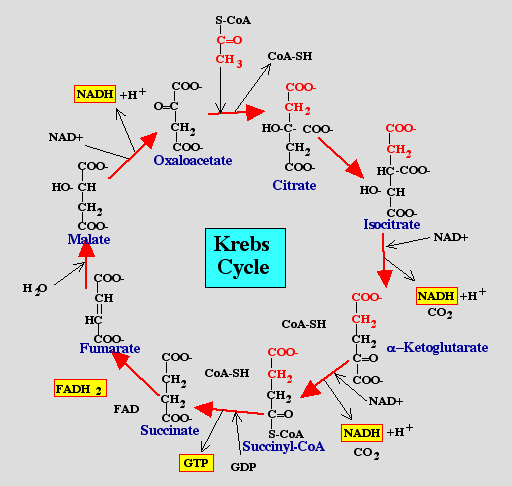
We oxidize in the Krebs cycle many moles of acetyl-CoA per day. The oxidants, NAD+ and FAD, are reduced to NADH and FADH2. In the cell there are only a few micromoles of NAD + and FAD and within the mitochondria (where the cycle occurs) the regeneration of NAD+ and FAD depends on the respiratory chain, so the Krebs cycle does not occur under anaerobic conditions. The Krebs cycle is like a "mill" where the "grain" (the substrate) is the acetyl group of acetyl-CoA and the "flour" (products) are CO2 and electrons (NADH and FADH2), the "millstone" are the enzymes and intermediate compounds.
Main bibliographic sources:
- Quintas A, Freire AP, Halpern MJ, Bioquímica - Organização Molecular da Vida, Lidel
- Nelson DL, Cox MM, Lehninger - Principles of Biochemistry, WH Freeman Publishers